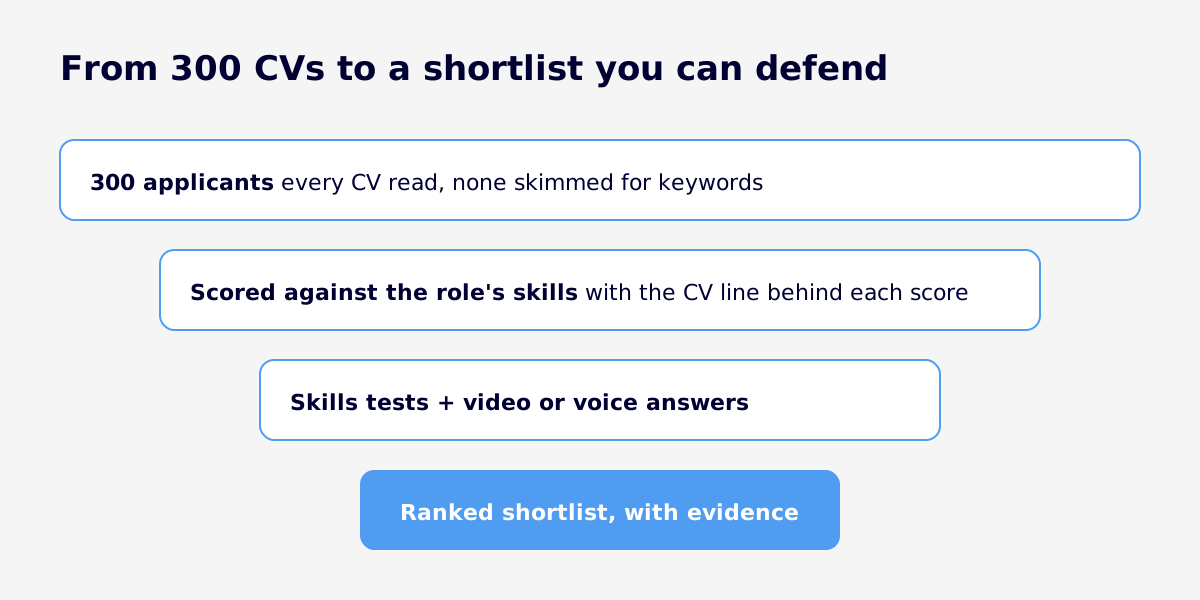
The role went live on a Tuesday. By Friday afternoon, Amara had 300 CVs in her inbox and a message from the hiring manager: "Can I have a shortlist by Monday?"
She knew how this weekend would go, because she had lived it before. Open a CV, skim for the right words, move on. Open the next one. Somewhere around number 80 the CVs start to blur. Somewhere around number 150 you stop reading and start guessing. And somewhere in that pile, maybe on page 12, sits the person who would have been the best hire of the year, with a plain CV that never used the keywords you were scanning for.
That is the quiet cost of sifting. Nobody sees the great candidate you missed. They just go and join someone else.
The weekend that didn't happen
This time, Amara didn't open a single CV on Friday night.
Every applicant had already been scored by Betrworkr A.I against the skills the role actually needed, not against a list of buzzwords. And each score came with the exact line from the candidate's CV behind it. When the A.I said someone was strong on stakeholder management, it showed her the sentence that proved it.
On Monday morning, the hiring manager didn't get a list of names. He got a ranked shortlist with the reasons attached. He could see who ranked first and why, and he could check the evidence for himself instead of taking anyone's word for it.
Going further than the CV
A CV tells you what someone says they can do. Amara wanted to see what they could actually do.
So the strongest candidates were sent role-specific skills tests, plus a few short video or voice questions they could answer in their own time, from wherever they were in the world. No scheduling across time zones, no first-round calls that eat a whole week. By the time anyone landed on the hiring manager's calendar, they had already shown their work.
The candidates who never applied
Here is the part that changed how Amara thought about hiring.
Her best candidate wasn't in the pile at all. The applicant pool is only the people who happened to see your ad. Betrworkr also searches the wider market for people in the right role, location and sector, including the ones who aren't applying anywhere because they're busy doing great work for someone else.
Those are the people your competitors are already reaching out to.
A search nobody could trace
The role was sensitive. The company was replacing a senior leader who hadn't announced their exit yet. So Amara posted it as a confidential search, and the ad hid the company's name. Candidates applied as usual. Only her team saw who they were.
The decision stayed human
None of this took the decision away from her team. A person still decided who to shortlist, who to reject and who to hire. The difference was that every one of those decisions now came with evidence first.
Amara spent that weekend offline. The hiring manager had his shortlist on Monday. And the person they hired was one she would never have found by skimming.
Your next senior role will bring its own pile of CVs. The question is whether your best hire gets found in it, or gets found by someone else first.